
JBL Synthesis just had its biggest year in a long time. Nine new speakers, a new subwoofer, two new processors and a new receiver were announced at ISE in Barcelona in February, began rolling out this year, and filled the Harman room at CEDIA in September.
If you’re planning a theater, the new gear deserves a serious look. But one question comes up in almost every conversation we have about it: “Is it Trinnov inside?”
For the new models, the answer is no. And getting that wrong is one of the most expensive mistakes in this category.
Why the Trinnov question matters
JBL Synthesis and Trinnov have worked together since 2015, and JBL’s top processor still runs Trinnov’s room correction. So people hear “JBL uses Trinnov” and assume every JBL box has it.
Here’s how that goes wrong. Someone buys an SDP 70 expecting the Trinnov Optimizer and gets Dirac. Someone else buys the SDP 80 because they want Trinnov’s WaveForming bass system, and it isn’t included. Neither product is bad. Both are the wrong product when they’re bought for the wrong reason, and at these prices a wrong reason costs thousands.
The family tree, in plain English
JBL’s processors grew up on two branches.
The Trinnov branch. The partnership was announced in October 2015, and its first product was the SDP 75, built on Trinnov’s Altitude32 platform in 16 or 32 channel versions. Its successor, the SDP 80, raised that to 36 channels and HDMI 2.1, and licenses Trinnov’s Optimizer room correction tuned to the Harman target curve. JBL describes it as an evolution of the SDP 75 with a new motherboard, new DACs and a new power supply.
The Dirac branch. The more affordable JBL electronics came from Arcam, JBL’s sister brand inside Harman. The SDP 55 processor and SDR 35 receiver were built on Arcam’s AV40 and AVR30. The SDP 58 and SDR 38 followed. All of them use Dirac Live for room correction.
2026. The new SDP 60, SDP 70 and SDR 40 continue the Dirac branch, now with support for Dirac Live ART, Dirac’s newer bass tool.
So the whole story fits in one sentence: one JBL processor runs Trinnov, the SDP 80, and everything else is Dirac.
| Type | Channels | Room correction | Listed price | |
|---|---|---|---|---|
| SDR 40 (new) | Receiver, 9 built in amp channels | 16 processing | Dirac Live | $11,999.95 |
| SDP 60 (new) | Processor | 16 | Dirac Live and Bass Control, ART sold as an upgrade | $7,999.95 |
| SDP 70 (new) | Processor | 24 | Dirac Live ART | $11,999 |
| SDP 80 | Processor | 36 | Trinnov Optimizer, Harman target curve | about $45,000 |
| Trinnov Altitude range | Processor | 8 to 32, depending on model | Trinnov Optimizer plus WaveForming | varies by channels |
Prices come from JBL and US retailer listings and change often, so treat them as reference points, not quotes. Retailers describe ART on the SDP 60 as an optional upgrade, so confirm what’s included before you buy.
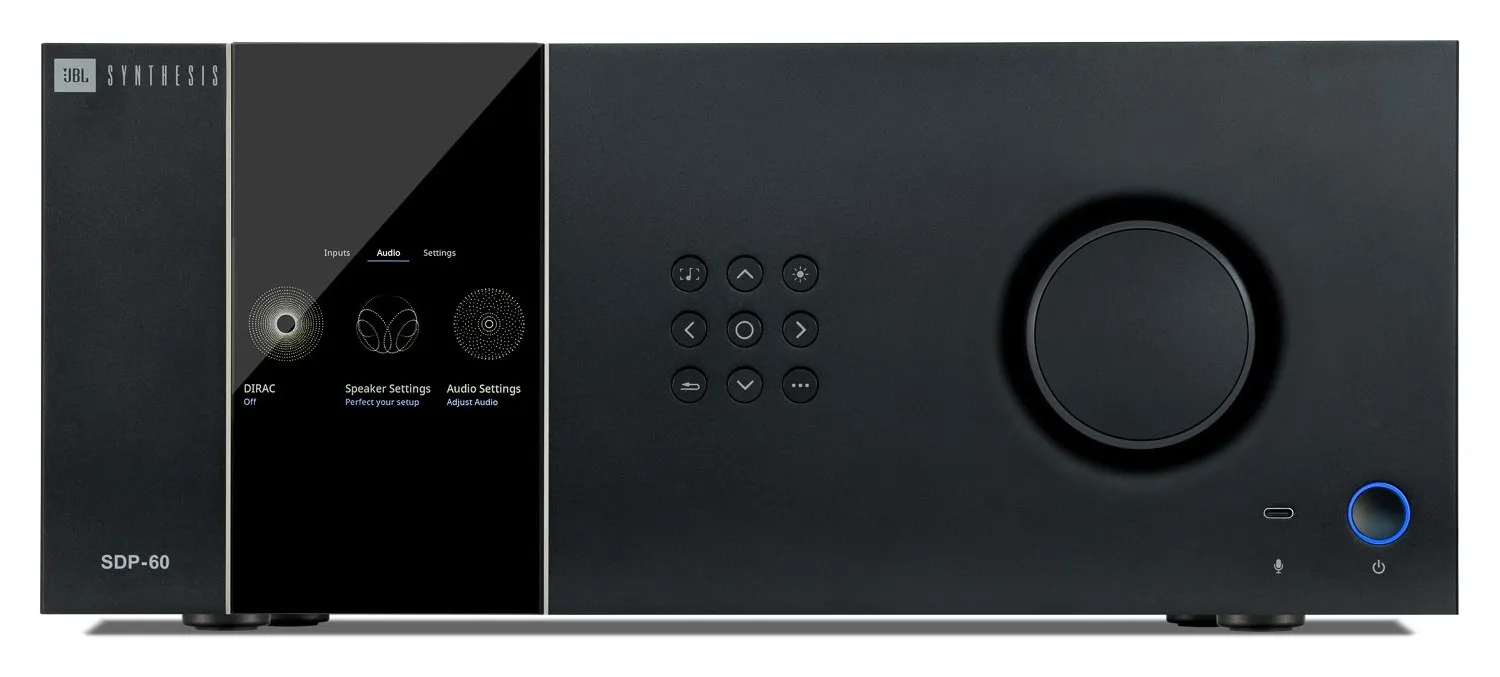 The SDP 60: 16 channels, Dirac Live, and the least expensive way into JBL Synthesis processing. Photo: JBL Synthesis.
We’ve already covered how Dirac ART and Trinnov WaveForming handle bass differently, and how to pick a processor by counting channels, in JBL Synthesis SDP vs Trinnov Altitude. This guide is about the new gear and where each piece fits.
What changed on the Trinnov side this year
Trinnov had a busy year too, and it changes the math.
Its installer focused processor, the AltitudeCI, started shipping in February. It works over network audio, and its channel count is licensed in steps that can be unlocked remotely, so a room can grow without a new box.
At CEDIA in September, Trinnov said WaveForming is coming to its entire Altitude range as a free software update, and announced an optional 10 year Extended Care plan for Altitude processors.
That announcement covered Trinnov’s own Altitude processors. It didn’t mention the SDP 80. So if WaveForming is the reason you want Trinnov, the answer this year is clearer than ever: buy an Altitude. The JBL SDP 80 makes sense for other reasons, which we’ll get to.
The new speakers are the real news
Processors get the headlines, but speakers decide what a room sounds like, and this is where JBL changed the most.
The new SCL line borrows from cinema design. The bigger models put a compression driver on a horn instead of using a regular dome tweeter. A horn controls where the sound goes. Less of it sprays onto the side walls and ceiling, so the sound stays clean in a hard room, the seats off to the side hear close to what the center seat hears, and the speaker plays loud without strain.
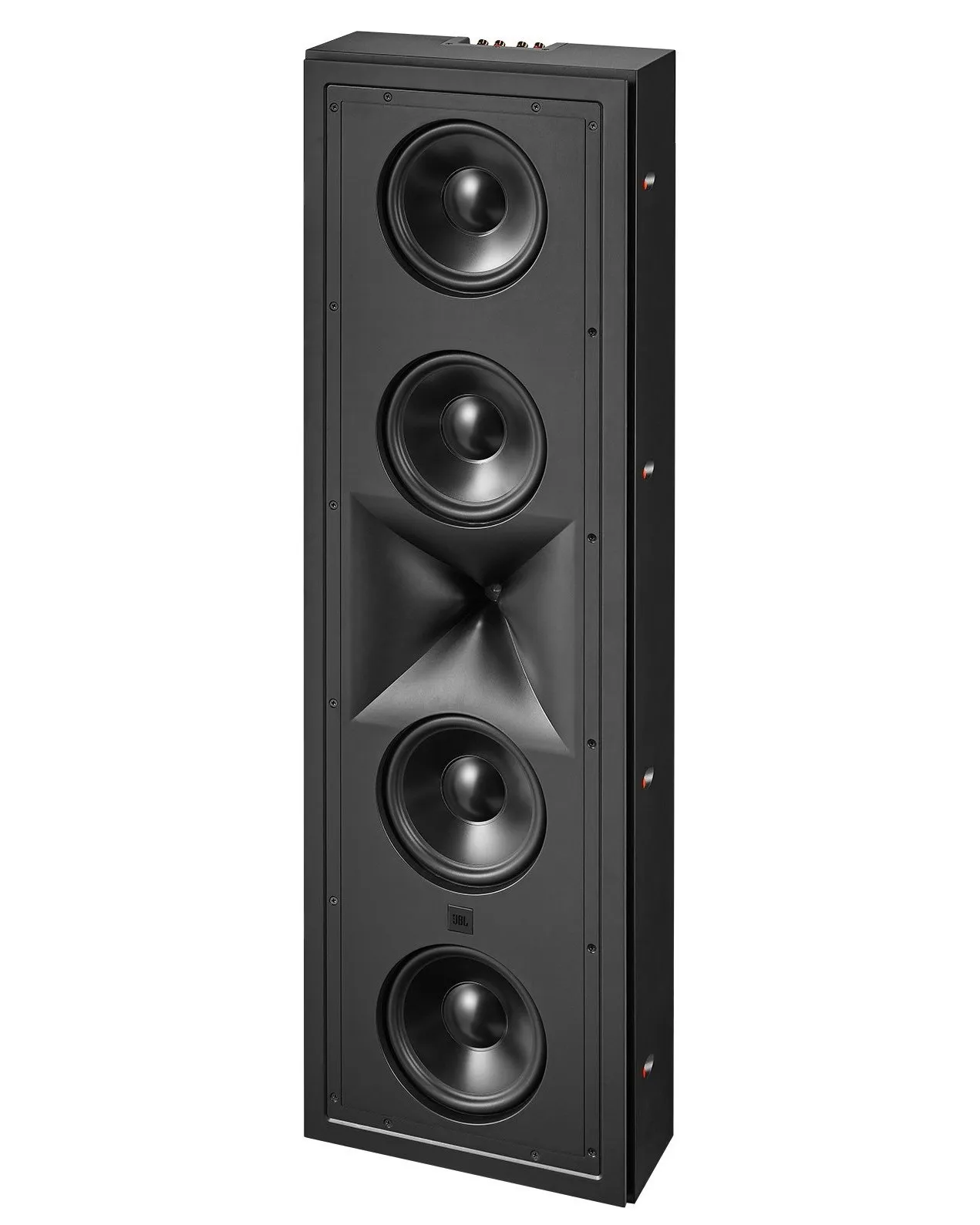 The SCL 2XL with its grille off: four 8 inch woofers around the HDI horn. Photo: JBL Synthesis.
The flagship in wall model, the SCL 2XL, shows what that looks like on paper:
- Four 8 inch woofers and a 1.5 inch D2815 compression driver with a dual diaphragm, dual motor design
- JBL’s High Definition Imaging (HDI) horn, covering 110 degrees side to side and 90 up and down
- 92 dB sensitivity, 4 ohms nominal and dipping to 3.2 ohms, 500 watts of power handling
- 53 Hz to 25 kHz
- Nearly four feet tall, 77 pounds, $8,999.95 per speaker
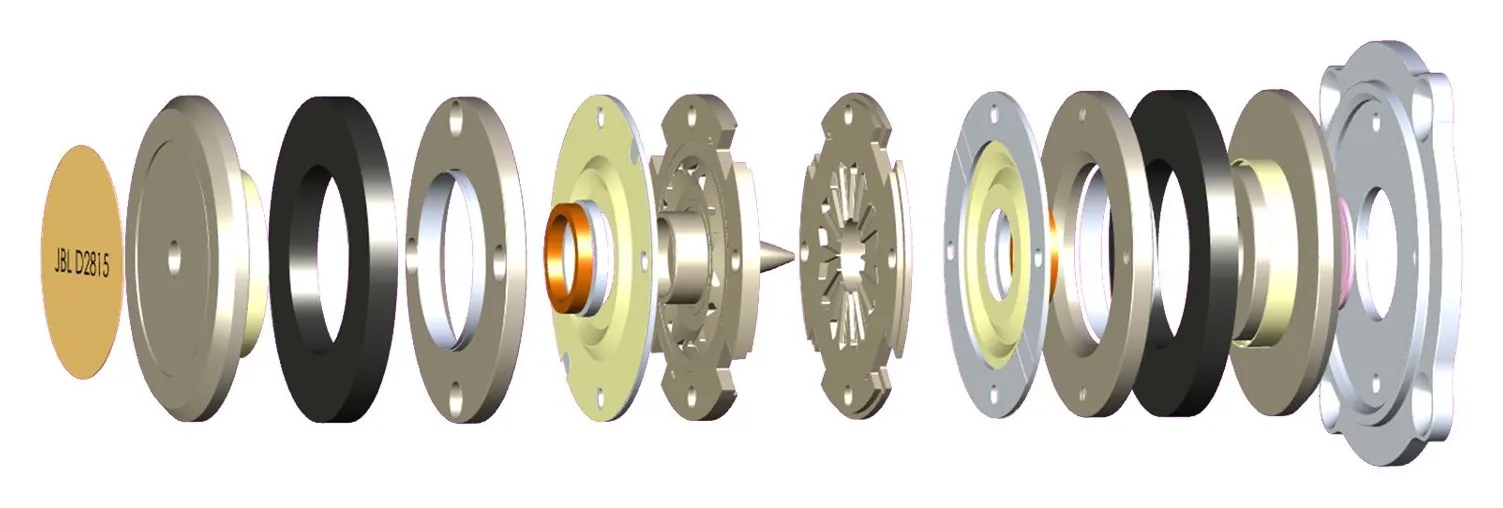 The D2815 compression driver, taken apart. It’s shared with the SCL 10XL. Photo: JBL Synthesis.
The rest of the line:
- In wall: SCL 4XL (two 8 inch woofers), SCL 6XL (four 6.5 inch), SCL 7XL (two 6.5 inch with an offset horn for surrounds and centers)
- In room and built in: SCL 10XL, the flagship, with two 10 inch woofers, plus the smaller SCL 10 with two 6.5 inch woofers
- On wall: SCL 9XL (four 5.25 inch woofers and a compression driver, for big screens) and the slim SCL 9
- Subwoofer: SSW 5, a 12 inch powered sub with a 1,000 watt amplifier, listed at $3,999.95
What the spec sheet doesn’t tell you
This is the part reviews skip, and it’s the part that decides whether these speakers work in your house.
The wall has to fit them. The SCL 2XL needs 5.4 inches of mounting depth and is designed for 2x6 framing. A standard 2x4 wall is only 3.5 inches deep. In new construction that’s a line on the framing plan. In a finished room, it means building out the wall.
The weight has to be supported. 77 pounds hanging in a stud bay needs blocking planned before drywall, not an afterthought.
The amplifier has to handle 4 ohms. A speaker that dips to 3.2 ohms asks a lot of an amplifier. That rules out a lot of receivers and is exactly why JBL sells dedicated amps.
Horns want a designed room. Controlled coverage is a strength when the speakers are aimed at the seats. Put them in the wrong spot and the same control leaves seats outside the pattern. Placement gets designed, not guessed.
Amplifiers: where the power comes from
JBL’s SMA amplifiers are the other half of the system. The SMA 8300 is the one we use most:
- 8 channels of Class D, 300 watts per channel into 8 ohms, 600 into 4 ohms (two channels driven)
- Pairs of channels bridge for more power on big speakers or subwoofers
- Built in DSP for EQ, delay and limiters, so each speaker can be tuned at the amp
- Dante and AES67 network audio ready, in a 2U rack chassis
- Around $6,000
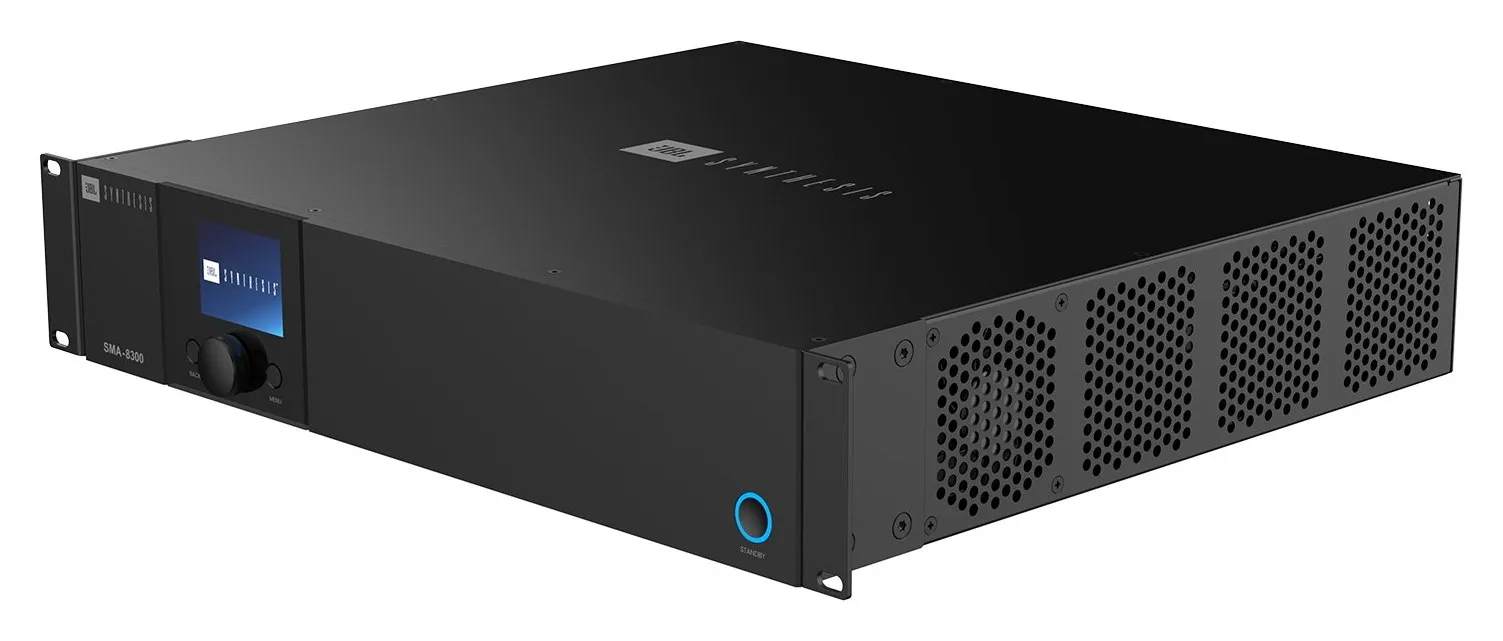 The SMA 8300: eight channels in two rack spaces. Photo: JBL Synthesis.
Its sibling, the SMA 4750, trades channels for power: four channels at 750 watts into 8 ohms, for subwoofers or the main front speakers in a large room.
The SDR 40 receiver is a different idea. It has nine Class G amplifier channels built in, rated at 100 watts each into 8 ohms with all nine driven, plus processing for 16. For a media room with efficient speakers, that can be the whole system in one box. Paired with SCL 2XLs in a big theater, you’d let the receiver handle the surrounds and put dedicated amps on the front.
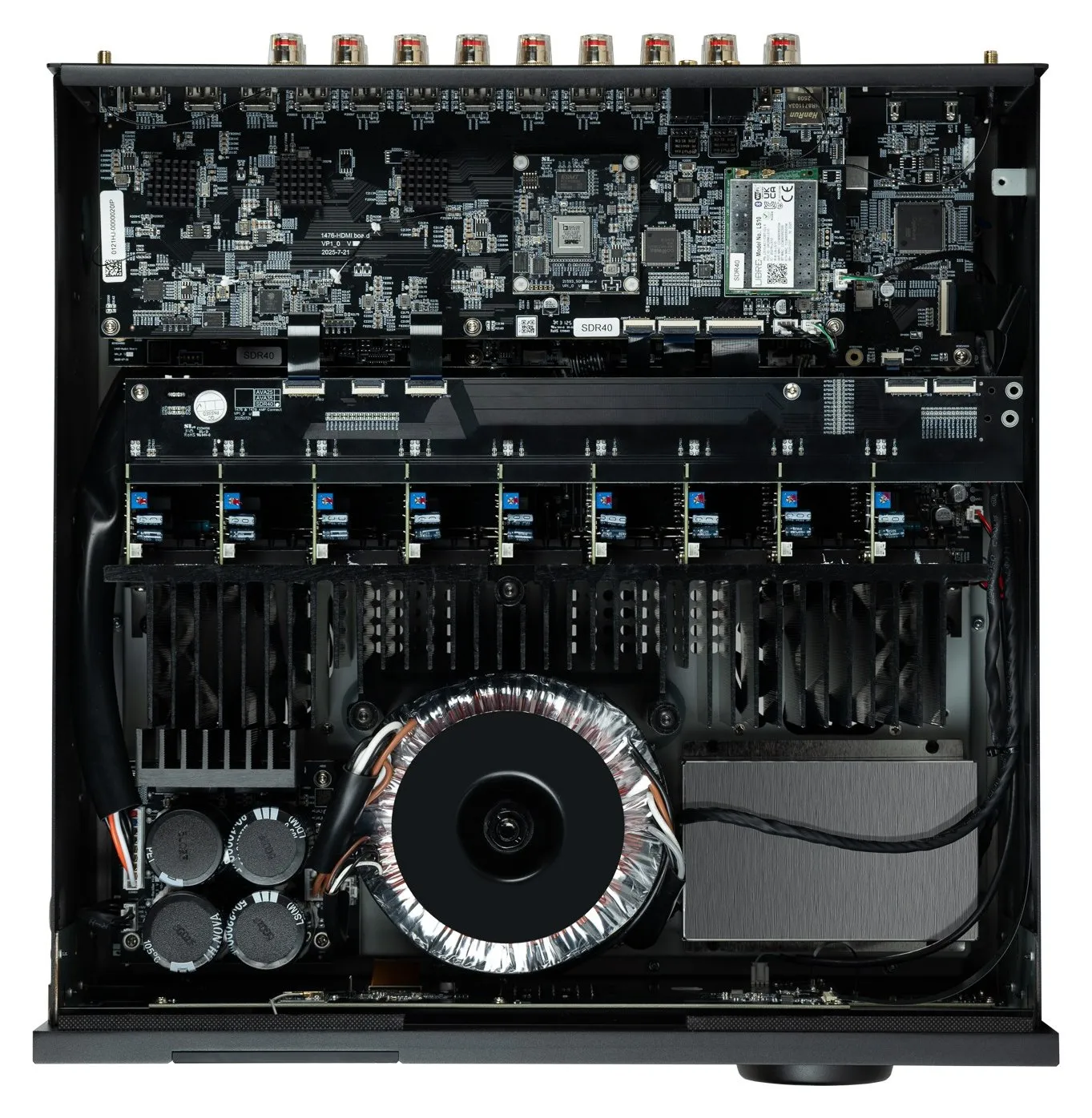 Inside the SDR 40: nine amplifier channels and the transformer that feeds them. Photo: JBL Synthesis.
We recently swapped an AudioControl Maestro X9 out of a client’s rack for an SDP 60, driving SMA 8300 amplifiers. That’s the kind of pairing the new lineup is built for: a 16 channel processor out front and rack amps behind it.
Which piece goes where
The brand on the processor matters less than the room it serves. Here’s how we’d match them:
- Media room, 7.1.4 or smaller, efficient speakers: the SDR 40 alone may be enough.
- Dedicated theater up to 16 channels: SDP 60 with SMA amplifiers.
- Up to 24 channels, or several independently controlled subwoofers: SDP 70 with SMA amplifiers.
- A room full of JBL Synthesis speakers, up to 36 channels, where you want Trinnov’s correction tuned to JBL’s own target: SDP 80. This is the one real reason to buy it.
- Seat to seat bass is the top priority and the room can take four or more subwoofers: a Trinnov Altitude with WaveForming, driving JBL speakers.
That last one surprises people. JBL speakers don’t need a JBL processor. A Trinnov Altitude running SCL speakers and SMA amps is a perfectly good system, and for some rooms it’s the best one.
The screen side gets the same room first treatment in JVC NZ900 vs Sony XW7000ES.
The questions we hear most
Is Dirac a step down from Trinnov? It’s a different approach, not a lesser one. Trinnov gives the person calibrating it more control, which pays off in a skilled setup and hurts in a careless one. A well calibrated SDP 70 will beat a rushed Trinnov setup every time.
Should I wait for a JBL processor with Trinnov at a lower price? Nothing like that has been announced. Plan with what exists.
Don’t horn speakers sound harsh? Older horn designs earned that reputation. Modern designs like the HDI horn are shaped for smooth sound off to the sides, not just straight ahead. Still, it’s a real difference in character, so listen before you commit, ideally in a calibrated room.
Can I keep my current speakers and just upgrade the processor? Often, yes. The processor and speakers are separate decisions. The amplifiers are where mixing and matching needs care, because the speakers’ impedance and power handling set the requirements.
The short version
One JBL Synthesis processor runs Trinnov: the SDP 80. The new SDP 60, SDP 70 and SDR 40 run Dirac, and that’s not a downgrade, it’s a different tool at a much lower price. The bigger change this year is the SCL speakers, which bring cinema style horns into the house and ask for walls, framing and amplifiers designed around them. Start with the room, then pick the speakers, then the amplification, and let the processor be the last decision.
Planning a theater around the new JBL Synthesis gear? We design the room first: where the speakers go, how the walls are framed for them, how the bass is handled and how much amplification it needs. Then we pick the processor and calibrate it in person.
Call or text (949) 275-1232 or email Ashkan@AlmondAV.com and tell us about the room. We'll walk you through which pieces fit it and what the full system looks like. You can also request a free consultation or see home theater design and installation.